Insights · November 14, 2026
How AI Agents Are Being Used in Public Relations Today
A grounded look at where AI agents are running real PR workflows in 2026, what they do well, where they fail, and how comms teams should deploy them.
By Samuel Edwards · Senior PR Strategist

How are AI agents actually being used in public relations right now? In late 2026 they handle media list construction, monitoring, draft outreach, and coverage parsing inside narrow, supervised slots of the workflow, rather than running campaigns on their own.
The agentic layer is not a single product. It is a stack of narrow systems, each doing one job that used to belong to a junior comms operator, and each handing off to a human at a defined point. Those jobs are already reshaping retainer scope, which is why AI-assisted pitching workflows now anchor most agency briefs.
Where Agent Adoption Actually Sits
Adoption lags the headlines. Agent usage among PR professionals remains a minority behaviour, and comfort with full autonomy is lower still. The product that looks magical in a conference demo is usually running in production with a human approving every outbound step.
That reluctance to hand off final decisions is what every vendor has designed around. Comms leaders are not refusing agents. They are refusing to hand off judgement calls that carry reputational cost. A near-universal majority of PR professionals say they would move faster if agents required explicit human approval before finalising a task, which maps to how most products have shipped. The result is a market where the loudest vendor claims assume full autonomy and actual deployments do not. Buyers evaluating tools in this period are mostly reading the approval architecture, not the model benchmark.
Monitoring and Research Agents Do the Prep Work
Monitoring agents are the lowest-risk pattern in production. They watch a defined set of outlets, podcasts, social surfaces, and LLM answers for mentions of a company, executive, or category, then cluster the hits, score sentiment, and queue the ones a human should see. The autonomous decision they make is small. Whether a given item belongs in the next brief.
Research agents run the same play for inbound journalist requests and outbound pitches. They pull a reporter's last 20 bylines, extract beat shape, note recent angles, and write a one-page prep doc before a call. The best versions pull from an internal CRM as well, so the prep doc flags journalists the executive has already spoken to. Muck Rack's Media List Agent, launched in beta on 2 February 2026, sits in this family. It reads a draft pitch and recommends which journalists should receive it, rather than sending anything itself.
A research agent spending 30 seconds on each of 40 journalists on a list replaces roughly 20 hours of junior analyst time, and the output is more consistent than what a tired analyst produces the night before a launch.
Outreach Agents Draft, Humans Send
Outreach is where agent design matters most and where vendors differ. Propel AI, launched 17 August 2026, is a PR-specific large language model trained on more than 25 million anonymised pitches and 500,000 journalist profiles, with the company reporting users saving over 20 hours a week on pitching and reporting workflows. MediaClaw, which debuted at PRSA ICON in October 2026 from the co-founders of Marketwire, chains further steps together: company research, press material creation, list building, personalised outreach, approvals, and coverage analysis, with pricing starting at $1,000 a month.
Both products encode the same bet. The bottleneck in digital PR is not drafting, but the sequence of judgement calls that take a story from angle to pickup. The best deployments still route every outbound message through a human who knows the journalist, which is why warm relationships compound in value as inbox volume rises. A pitch written by an agent and sent by an operator with a prior exchange lands differently from the same pitch sent cold, and placement rates confirm it.
Measurement Agents Close the Loop
Measurement agents are the cleanest fit for autonomy because the output is a report, not an outbound action. They parse syndications, flag canonical and nofollow treatment, map placements to organic ranking shifts, and increasingly check which placements are being quoted inside ChatGPT, Perplexity, and Claude answers for target queries. The output replaces the coverage deck a junior used to assemble by hand. The better versions connect to Google Search Console, a backlink index, and an LLM-citation tracker, so a single query answers whether last month's placement moved rankings, not just whether it went live.
For agency teams, this is where retainer scope is shifting fastest. A measurement agent folded into a digital PR engagement changes the review conversation. Not placements counted, but which placements moved pipeline, rankings, or AI citation share. Linking placements to AI-generated brand mentions is becoming standard rather than premium work.
The Trajectory Gartner Is Pricing In
The adoption floor is low. The ceiling vendors are building toward is not. Research firm forecasts for enterprise agentic AI are unambiguous about direction, if not pace. Autonomous agents are expected to carry a growing share of day-to-day work decisions across functions, PR included. In comms specifically, the near-term shift is less about replacing roles and more about collapsing the time between a news event, a drafted response, and an approved send.
That trajectory is why the Public Relations Society of America has published ethical guidance specifically on AI agents, covering disclosure, accountability, and the duty of counsel to understand how a system reaches a recommendation before acting on it. That framework is the backstop teams are using to decide which agent decisions can be autonomous and which must stay with a human.
Wiring Agents Into a Human-Led Newsroom
The teams getting value from agents share a pattern. They treat each agent as a role, not a tool: a named monitoring agent, a named research agent, a named outreach drafter, each with a defined input, a defined output, and a human owner. The owner reviews logs every week and prunes failure modes rather than waiting for a quarterly audit.
The approval gates stay where the reputational cost is highest. Monitoring and measurement run autonomously. Research runs autonomously with human spot-checks. Outreach drafts autonomously and sends only after a human reads it. The outreach QA pass stays manual at every agency doing this well, because a bad send to a tier-one reporter is not recoverable at agent speed.
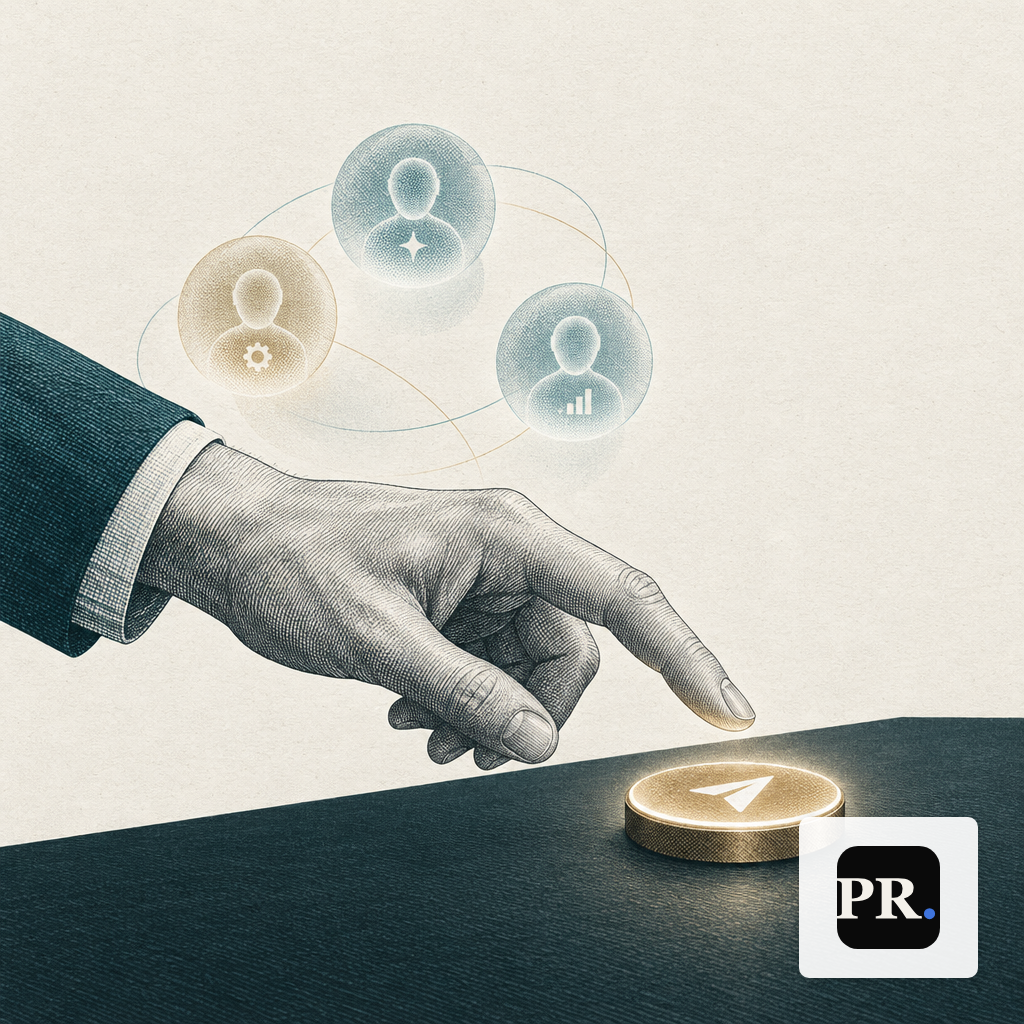
Return to the opening question. An AI agent in public relations today is not an autonomous operator. It is a junior who never sleeps, drafts quickly, and stops before the send button. Teams restructuring around that reality are spending less time on list hygiene and coverage decks, and more time on the two parts of the work that agents still cannot do: deciding which story is worth telling, and knowing which journalist to tell it to.